Announcing The Hymnal NFT collection, and a declaration of our intentions
over 4 years ago
– Tue, Dec 21, 2021 at 05:21:53 PM
So. NFTs.
Right off the bat, I want to acknowledge the elephant in the room: NFTs are a steaming pile of mimetic sludge and I have to assume that some of our backers are seeing this subject line and feeling betrayed, hurt, or frustrated that something else they like is being corrupted by NFTs in the near future.
I dearly wish to use this moment of adversity as an opportunity for me to free your mind a bit. If you give me a chance to express a more nuanced perspective around this subject than many of us are getting from social media arguments and lopsided clickbait, I think you’ll leave this update feeling lighter and perhaps even excited about the future. All I ask is for the benefit of the doubt; I am here typing this in good faith, I do not think less of you for your principled stand, and I ultimately recognize your impulse as one grounded in love for the world. I share that impulse, and I want to clear up some misunderstandings.
From what I have heard, the primary grievances around NFTs as a class of technology are the following:
- #1: They are a nightmare for the environment
- #2: They are a cesspool of scams, ponzis and pyramid schemes
- #3: They are entirely useless and you can copy/paste them easily
- #4: They make it easy to steal the work of artists with zero recourse
- #5: They solve no real problems, and only make the rich richer
If you believe all of these things, then I am hopeful I can at the very least soften the intensity with which you believe them. Only once I have fully addressed these grievances will I bother you with the proper announcement of exactly what kinds of NFTs we will be producing, what they’ll give you, and why we’re doing it. If you hold none of these grievances, feel free to scroll down to that part, and thank you for understanding this massive disclaimer (it was 10 pages long according to OpenOffice, so strap in. :)
Before I address these grievances, though, I feel it is important to demystify exactly what an NFT is. There's an enormous amount of disinformation roiling in the web right now, much of it spilling out of the mouths those who claim to love NFTs. Lots of people don’t get it, don’t know that they don’t get it, and are being assholes about that, on every side of this controversy. Artists who use NFTs are getting death threats and losing fanbases, and NFT avatar cryptobros are attacking those who publicly denounce them. It’s a big ugly mess, and a lot of decent human beings are getting harmed and dissuaded from learning something new. That makes me sad.
NFT stands for Non-Fungible Token, a somewhat esoteric acronym that basically means “You can now own virtual things.”
The way that this is possible is thanks to a revolution in decentralized ledgers – also known as blockchains. Blockchains are databases of information, like a history of financial transactions, except these databases are duplicated on a whole bunch of different computers that are running a program which makes them all update at the same time.
The reason people think this weird ritual is valuable enough to invent, is because it creates a system that nobody controls, and yet is able to convince everyone to believe that a thing is true. Even if you hate bitcoin and wish it would go away, I can still show you my wallet address, tell you that I own some, and you believe me. You have a rational reason to respect its market value, even though it wasn’t issued by a bunch of people with guns. Normally, you need a bunch of people with guns to make money valuable, because whoever has the guns prints the money, but now, we figured out a way to make money without guns, and people still respect its value. Neat.
As it turns out, these decentralized ledgers can track things besides financial transactions; weirder things like the execution of computer code. You know how your computer has a hard drive that records data, and a processor that lets you run programs and stuff? What if you duplicated that whole thing a whole bunch of times and had a whole bunch of people all running mirrors of the same computer? What if anyone in the world could access one of these mirrors and run code that they wrote? What could you do with that?
This is a primitive way to explain what the Ethereum network is. You’ll see it called ‘The World Computer’ sometimes (which lights up my Norse mythology neurons…). It is a single computer, except instead of being a gigantic server room at Google HQ or something it takes the form of thousands of smaller ‘nodes’, each of which is keeping its own record of all the things that the computer has been doing. And one of the things that we have figured out it can do, is give people provable ownership of intangible data in the form of an NFT.
On a technical level, an NFT is a bundle of information that can only be moved around and changed within the World Computer by the person that owns the key that unlocks it. Now, that probably doesn’t demystify the concept. And it sure hasn’t addressed any of the grievances. So let’s kill two birds with one stone, and dive right in.
Grievance #1: NFTs are a nightmare for the environment
Of all the grievances, I believe this one has the most substance, so I’d like to address it first. If this is your first time learning about NFTs, I’ll need to give you some more exposition.
Blockchains – decentralized ledgers – are made possible by gigantic networks of computers that are all turned on and running at the same time, all day long, processing information from everybody who uses the network. That by itself probably sounds like a lot of energy, but it gets worse: both the Bitcoin and Ethereum networks (and most others like them) are designed to make the computers securing them run AS HARD AS THEY POSSIBLY CAN. The harder the nodes run (and the more energy they consume), the more secure the network is, and the more likely the person who operates the node will receive compensation in the form of a cryptocurrency, such as BTC or ETH. Because of this, people who run these nodes have a big incentive to invest in farms of ASICs (specialized graphics cards) so that they can make computer go fast. This intense process is called ‘mining’, and the first time you learn about it, it usually sounds insane. It doesn’t make sense.
So...gosh, how to explain this one.
When the person that made Bitcoin was designing it, the only way they could make it work was if there was some kind of a computer trick in place that would keep people from cheating. In the old system, you’d just send someone with a gun to throw that guy in prison – but this system is supposed to make that violence unnecessary. So, in order to add information to the blockchain, nodes have to prove to everyone else that they have done a certain amount of work, by attempting to solve a very complicated puzzle based on whatever info is in the next page (or block) of the database. The more people that run nodes, the more work each node must prove they’ve done, in order to be given permission to add pages to everyone’s copy of the ledger.
There’s more to it than this but the end result is that if you wanted to cheat the Bitcoin or Ethereum networks and make everybody’s computer agree to believe in your scheme (such as “I have more money than I actually have”), you would need to override everyone else’s truth. And the only way to do that is to have more than half of the network’s computing resources working together to do your bidding. They call this a 51% attack, and if you can’t pull one off, you can’t hack the network. Mathematically speaking you would need to have as much computing power as an entire nation state all working in tandem to specifically attack and devalue one of these networks, and the reason that cost is so high is because the cost is intentionally high – you have to prove your work! This level of coordination is unlikely, and that’s why people have trusted Bitcoin and Ethereum to remain valuable over time. Neither has ever been successfully subjected to such an attack.
The fact is, this system of achieving consensus (called Proof of Work, or PoW) is totally expensive! It uses a ton of energy (much of which comes from the burning of fossil fuels), and a ton of computing parts (manufactured with rare minerals often mined under extraordinary human rights violations), all just so that the network can run without someone breaking its legitimacy. All of this is true, and it is important to own it.
The problem with taking this information and drawing the conclusion that NFTs are bad for the environment from it is...well, there’s a couple problems.
1: NFTs Are Not Created Equally: For one thing, Bitcoin and Ethereum aren’t the only networks that allow for the creation and trade of NFTs, and many of the other networks that have NFT ecosystems don’t use Proof of Work as a consensus model. This basically means that NFTs minted on Solana or any number of other sidechains or layer 2 chains by default burn about as much energy as sending an email does. These chains use Proof of Stake, a model that requires validators to prove they care about the network by putting down money in order to become a node, and it’s a pretty neat trick that makes the whole asset class way more sustainable.
I recently saw a wonderful artist named Woonyoung Jung get cancelled by a sizable chunk of his own fanbase after announcing a collection of NFTs he minted using the Solana blockchain. These NFTs are basically about as bad for the environment as posting on Instagram is. But people don’t understand that, nor do they want to hear it, and many still see it as a nihilistic cash grab. The guy did his homework, tried to mint in a way that his fanbase would understand as more conscious and environmentally sustainable, and still had to mute comments on his posts about it because of the vitriol with which people were reacting.
It is absolutely worth mentioning that the Ethereum network is in the middle of a multi-year migration from Proof of Work to Proof of Stake; the people who develop this system want it to be environmentally sustainable and are working day and night to bring it in alignment with a brighter vision of the future.
2: Miners Validate Blocks, Not NFTs: There’s also the issue that its impossible to ascribe a meaningful ‘energy cost’ to the minting of a single NFT because of the way that blockchains are secured. The network is on, and running, and it uses the same amount of energy to stay on and running whether people are using the network or not. If we all decided tomorrow to stop playing with NFTs, the Ethereum network would still burn energy. The chain moves forward like a clock, like a train, and your NFT is like a passenger. If you don’t get on the train, the train still goes. This is important to explain because earlier this year a website called CryptoArt.WTF published a calculator that looked at random Ethereum-based NFTs and delivered you a neat little sum of just how much energy that NFT has burned based on how many times its been bought and sold.
But that’s bad math!! You can’t tell how much energy a single NFT has emitted when its being tracked in blocks with tons of other transactions. If you look at the energy cost of validating a single block, that block contains so much more data than just the data of an NFT being bought or sold. If you’ve heard that creating a single NFT emits two years worth of the average German family’s energy use, that’s based on this website, which has since been taken down and replaced by a (evasive) disclaimer right up front apologizing for just how damaging this site became for artists curious about this stuff. Unfortunately, the damage has been done, and many people have an extremely deep aversion to NFTs on this idea alone. It’s quite unfortunate. Hence the essay.
3: This System Can Replace Old Systems: Do you know what I’ve always resented as an artist and entertainer? The pressure I’m under to manufacture and ship huge amounts of meaningless crap just so that I can make a decent living. I don’t want to be a T shirt company, and I don’t want to make a whole bunch of stickers and mugs and sweaters and keychains and assorted other nonsense that is more than likely going to be worn a few times, forgotten, donated and then dumped into the freaking ocean. I have been to Disneyworld and I gotta tell you, knowing that the climate is imploding and looking at a shelving unit eight columns deep filled with “happy 2021” limited edition mickey mouse statuettes gives me a sense of despair and powerlessness that is hard to put into words. This crap doesn’t matter. It isn’t useful, it fills up our world with nonsense and the manufacture, shipping, and storage of all this uselessness is contributing to the onrushing inevitability of our extinction.
Now I don’t really have any numbers to back this up, but if ol’ Mickey decided to stop making statuettes and instead issued a couple thousand limited edition NFTs of the same model in a single transaction – I bet you that would cost less energy and be lighter on the earth, and somehow provide more value to the end user!
It’s easy to lose sight of the systemic angle here, but NFTs as a technology class – even those minted on the Ethereum proof-of-work network (which, again, is migrating to the much more sustainable proof of stake in 2022) solve a huge inefficiency in the capitalist hellscape that we as young creatives are forced to exist in. And the environmental impact of changing from meaningless, frivolous physical crap manufactured as a commodity just to sell people things they don’t need, and putting all that energy somewhere virtual? That, to me, seems like a much needed SOLUTION to a part of our environmental calamity. We have to establish systems that stop incentivizing well-meaning people to make, sell, and store objects that serve no real human purpose beyond being sold. That should all go virtual, and we should celebrate the chance to make it so.
Okay.
Hopefully that’ll do for Grievance #1.
I will attempt to address grievances #2 through #4 together, because they are all cleared up with a closer look at what NFTs actually are.
Grievance #2, #3, and #4: NFTs are a cesspool of scams, ponzis and pyramid schemes; They are entirely useless and you can copy/paste them easily; and They make it easy to steal the work of artists with zero recourse
If I understand this correctly, there are two reasons for these grievances. The first is that there are provably a ton of scammers in the space. Come to think of it, there are a ton of scammers on earth. Capitalism incentivizes people to get as much money as they can with as little effort as they can and one of the best ways for a morally dubious person to do that since the dawn of money has been to trick other people out of theirs. NFTs can be used to do this. There are a lot of people who knowingly sell useless tokens to those who don’t know any better and think it’s their ticket to freedom. In my opinion, the only solution to this is better education; scammers can’t scam the wise.
The second reason for these grievances is simply due to how weirdly this technology works. From the outside looking in, even legitimate and thoughtful projects appear to show a bunch of clever tricksters making fabulous sums of money in the creation and sale of virtual things that don’t seem to have any substance or tangible reason to be so valuable. If I sell you an NFT that looks like a piece of art that I made, you can just right click and save that piece of art, so...why are people speculating the values of these little images to the point where some of them are quite literally trading for millions of dollars (worth of ETH)? The natural response is to assume there’s some great heist being exacted on the hopeful dupes who have drank the medicine and think that NFTs matter.
To address these grievances, you must understand that NFTs are not images, and the image that an NFT is tied to (or rather, that it points to) is not what the token ‘is’. The image, sound, and text contained within one of these tokens is just set dressing. So then what are they, really?
In a nutshell, NFTs are tokens which allow people to claim an abstract thing called ‘provenance’ – you can prove that you own a thing. The ‘substance’ of an NFT has a lot less to do with what it looks like, and a lot more to do with the kinds of doors that this provenance can open. Which is to say, owning certain NFTs gives you, the holder, all kinds of special cultural, social, and mechanical privileges that you cannot access without that token in your possession.
One of the most notorious NFT projects right now is called the Bored Ape Yacht Club. This project was created in the model of a precursor (called the CryptoPunks), and on the surface it looks like 10,000 uniquely generated .jpegs of cartoon bored apes. Some of them have hats. Some of them are gold! A machine learning algorithm took an artist’s inputs and then randomly generated a whole bunch of these pictures, tied them to a whole bunch of NFTs, and put them out into the world where people could ‘mint’ them (I’m paraphrasing here, the technical process was a little more specific than this). They are now one of the most valuable collections in the entire space. Holding a Bored Ape Yacht Club NFT, well...it gets you in the Bored Ape Yacht Club. This means access to a community discord; access to IRL BAYC events; access to limited edition merchandise, and perhaps hardest to quantify and also most valuable: you get to say you’re in the Bored Ape Yacht Club and that be recognized as truth, thanks to the Ethereum blockchain. It has gravity. Whatever you feel about it, it means something.
How about another club? Poolsuite.net. This is a website that started off as just a chill place to listen to curated playlists and watch 90s-era advertising for the vibes of it all. It’s a pretty well-designed website with some neat old school Macintosh desktop UI that makes you feel like you’re hanging out at home in 1997. For millennials this kind of nostalgia is water in the desert – y’all remember being optimistic?
When I found out that Poolsuite was releasing an NFT – the Executive Member NFT, designed to look like they fell straight out of a luxury American Express magazine ad – my interest was piqued, and I was fortunate to acquire one for a fairly small cost. It wasn’t until I went back to the poolsuite website that I realized just how many kinds of experiences NFTs make possible. Without logging in, without doing anything fancy at all, the website automatically detected the presence of the Executive Member token in my browser wallet, and suddenly a 3d animation was playing, showing a gold membership card sliding into a slot in the center of the website itself. The whole design changed; I was now listening to the Ritz Foyer members-only playlist, the background was all gilded and fresh, and there were new site selections available to me. It was all a little showy, but that’s kind of the point – it’s perfectly on brand for this website, and it could just as easily provide a different experience somewhere else. This was a unique emotional moment that was curated for holders of this token, and not only can I have this experience...if I want to, I can sell it to someone else. It isn’t something locked inside my account in poolsuite’s servers; I have provenance over this experience, and I can give that provenance away. For that matter, I have provenance over any other experiences that are ever developed by anyone that wants to add functionality to this token (so long as I keep it). It’s all open source, baby! I could literally build my own video game universe for Executive Members just to make other people in the club like me. I probably won't, but I can if I want to.

In a less mechanical sense, having provenance can be as simple as having your name on the placard next to the Van Gogh, since you were his first patron. Metakovan will always be the primary buyer of Beeple’s legendary $69 million NFT, and we will always be able to point to the chain and see that historical truth within the token’s data. Humans are social creatures driven by storytelling, and if you believe (as I do) that the Ethereum blockchain is resilient enough to survive the next few thousand years, then having provenance over a part of this historical record is...pretty badass.
(And if you think about that timescale, and about the future, you’ll come close to another neat thing about the provenance granted by these tokens: they can stake your claim to things that don’t exist yet, but will. This is Kickstarter meets Indiegogo meets Venture Capital, and then some. And this is the reason that we are moving to release some of our own.)
‘Provenance’ is also the reason why the grievance about artists having their work stolen doesn’t hold much water. Provenance is an abstract thing. What does an NFT confer? If an artist issues an NFT, they can honor that NFT in any number of mysterious ways in the future. Maybe it gets you into the club on the website? Maybe it gets you access at live events? Maybe it gets you a special necklace you can wear in the metaverse? All of these things must be built first, and if you hold a fraudulent NFT, your token will only be able to access these things if their creator, for whatever reason, decides to honor a fraudulent token. Meaning it’s worthless, unless they’re some kind of avant-garde performance artist. I recognize that it feels bad to see someone right click and save your work and then try to sell it as an NFT for a quick buck. That’s a pretty scummy thing for someone to do. But it’s important to recognize that the person being scammed is not the artist – it is the buyer of the fraudulent token! The artist’s legal provenance over that work is still intact, they have lost nothing, and nothing has been taken from them. If you don’t grasp that, you can’t fix the real harm being caused to duped buyers, and you can only fix that by educating the people who are being scammed (and pressuring OpenSea to verify collections faster). If you’re going to buy an NFT, take a moment to make sure that you trust the person you are buying it from.
At any rate, it doesn't make sense for someone to claim NFTs are meaningless and can be copy/pasted, and also claim that someone minting a fraudulent one is somehow meaningfully stealing from them. These two ideas contradict, and I hope this has explained why.
Grievance #5: They solve no real problems, and only make the rich richer.
Should I gather a stack of anecdotes about Zimbabwean painters getting their work seen in Times Square, about people pulling themselves out of financial hardship by playing Axie Infinity, about queer people, women and people of color becoming six-figure income full-time artists, and all the other wild ways that folks who are normally gatekept out of the games have no firm gates keeping them out of this one?
It’s easy to feel FOMO in the NFT world, when some people seem to have turned a few dollars into millions; always the people on the inside, ‘in the know’. I wasn’t paying any attention to Larva Labs when they made the CryptoPunks, but if I was, I could’ve gotten one for free. They now regularly sell for hundreds of thousands of dollars, based entirely on the cultural pedigree that they represent: they are the first successful ERC-721 10k generated profile picture project. They’ve inspired countless copycats and imitations. And they’re pretty cute, man. Let’s be real.
FOMO can easily turn into resentment and dismissal. I see it all the time. Every time some new project gets a bit of the zeitgeist and the floor prices start climbing, you see people gripe about how this collection isn’t really that cool and it’s gonna crash and it doesn’t have enough utility and yadda yadda yadda. This is often just people who missed the boat being upset about having missed the boat. I, too, feel upset when I miss the boat. But if you think this whole space is just the rich getting richer, you’re missing two big things:
- It can cost very little to get on the next boat. If you’re paying close attention, learning the technology, and engaging with other people in the space in an open and honest way, that is. The Cryptopunks were free.
- You can build your own boat.
Not only can you build your own boat, but if you’ve got a solid enough schematic you can get people to give you the economic power you need to build that boat, and in so doing, deliver an outsize return to those supporters that you’ve never been able to deliver before. You can really and truly empower your community in a way that I have never freaking seen before.
Let me give you an example.
The Ethereum Name Service (or ENS) is a protocol created by a group of developers who thought it would be nice to have a human-readable name associated with a blockchain address, so that instead of “0x9BBD84d92Db21D628BF78e2196677bB9F10366d3" you can just type in “danieljamesdrake.eth” and find my public wallet. It’s basically the same thing as a Domain Name, but instead of pointing to a website, it points to my wallet. This is handy for a lot of reasons, and when I found out about the project I decided to try it out, and secured the ENS domain “anthromancy.eth”, in the form of a simple NFT that now rests in my wallet. It let me claim it for a long time, without charging me a lot more, because this isn’t a contract with a company – its code executing on the world computer. Why only claim an ENS name for 3 years when it only costs a little more to claim it for 30 years? Smart contract questions.
Fast forward a couple of months, and I started to hear people on twitter talking about the ENS airdrop. It turns out that the people who founded the protocol and controlled the contract had decided to decentralize ownership of this protocol, which is to say, they granted their early users a bunch of governance tokens called $ENS. The main utility of these tokens is that they allow the community of holders to vote for different changes to the ENS protocol, meaning that they effectively hold a direct democracy over the development of this public good. Initially I felt a lot of FOMO because I don’t have an iPhone and I hadn’t yet figured out that the concept of ‘airdropping’ isn’t tied to the iPhone ‘airdrop’ feature. *facepalm*
I finally pieced it together when I went to secure another ENS name, and this time, the website gave me a little alert letting me know that I might be eligible for the airdrop. I clicked it, it took me to another page where the website checked my wallet and saw the NFT that proved my provenance; I had secured anthromancy.eth before the cutoff date for eligibility. So according to their rules, I was entitled to 70 $ENS, conferring a small amount of voting power over the future development of the protocol. I thought that was pretty neat. Then I hopped over to check the market value, and found that $ENS was trading at about $50 apiece. Meaning I’d just been given close to $4,000.
It was at this moment that it clicked.
If you believe this technology solves no real problems and only serves to make the rich richer, help me understand why, under traditional capitalism, the creators of a valuable service would ever rescind ownership over their own project to its community of users and in so doing gift every one a sudden grant of $4,000 at the minimum?
That...doesn’t happen. Keep in mind, I secured anthromancy.eth for my own self-interest. I wasn’t trying to do them a favor. The point of legacy capitalism is to extract value from your users, not to give it to them. And you certainly cannot give them ownership over it. There’s something really, really strange that’s happening here, where somehow creators are being incentivized to make incredible tools and art and programs and designs and experiences and then give them away for as little as possible in order to manifest fabulous wealth in the lives of the people who are using it, and who helped manifest it.
It sounds insane when you put it like that, but that is one of the things that is happening, and when filing grievances about NFTs and cryptocurrencies with a broad brush, it’s easy to miss the beauty of this. This is a system whereby value that has always been extracted from you can now be captured and instead delivered TO you.
I would happily argue that this is a real solution to a real problem.
Musicians who sell NFTs of their work can auction off the provenance of a 1/1 tied to a song while still sharing that song widely with the world. In fact, the more widely and freely the art tied to the token is shared, the more valuable the provenance associated with it becomes. The more times you right click and save a Bored Ape, the more notorious that ape and therefore the more value it represents. The value of stories, the value of experiences, the value of tools, the value of communities, all of this can now be captured in a way that takes that abstract and floaty notion of ‘goodness’ and transforms it into useful economic and social power, allowing its beneficiaries to manifest better futures for themselves, their loved ones, their fans, their communities, and ultimately the world as a whole. We are all connected. If we find ways to raise each other up, we all benefit from that. This class of technologies opens a path to more of that.
I want more of that.
Well, that’s me addressing these grievances.
If at this point, you are still convinced that NFTs are a mistake, then perhaps there isn’t any reconciling that. At the very least, I hope you’ll respect what must look to be an extremely elaborate justification for my moral ineptitude. I do not believe it is ethical or moral, having stated all of these opinions, to hold back from exploring this technology in ways that make sense for the Anthromancer brand, just to appease people. I have too many strong incentives at work here. I want to get my team paid. I want to pay off my debt. I want to help my partners and my exes and my friends and acquaintances and if weird wizard money and aetheral item sales is a path towards doing that, then frankly I invite the cancelling. As with many things, the backwards law is in effect, and if a bunch of people suddenly start complaining about this decision it will just help me out, cynical as that sounds.
More than any of this...I want to build something really, really cool, and then share that with the world for free. For the first time in my life, that is a practical, actionable goal. That’s the path to ‘making it’. Can you believe it?
I can.
Without any further ado, I would like to formally announce…
THE HYMNAL COLLECTION.
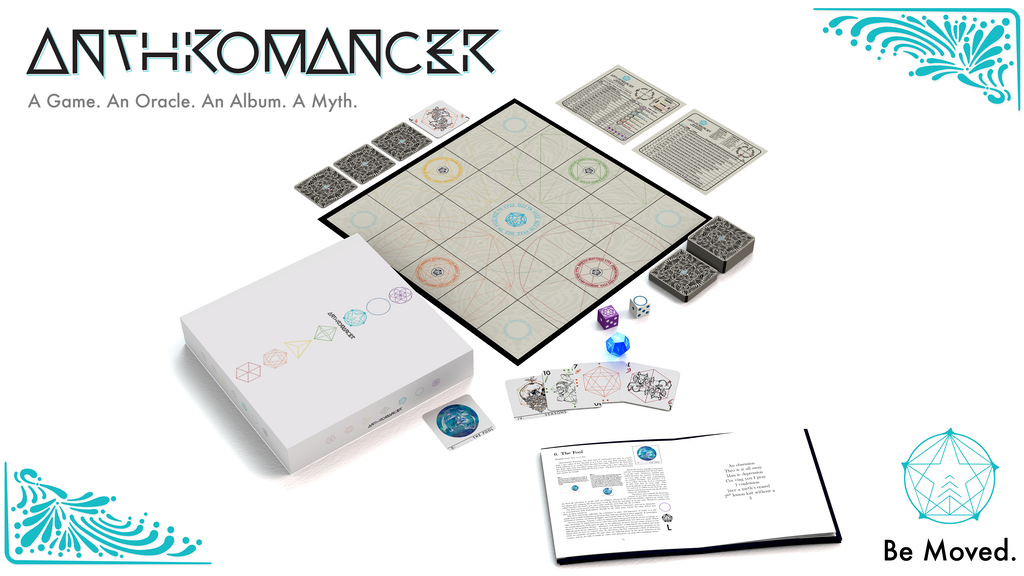
The Hymnal Collection will be a collection of (15) 1/1 NFTs designed by yours truly and illustrated by Calen Blake. These tokens will take the form of square, floating gaming cards, corresponding to the fifteen "hymns" of the Anthromancer game system. Each hymn is a song, a game effect, and an oracle meaning bound in one (but y'all already know that). The final look of the tokens will be quite similar to the lyrics videos we released a while back, but we're taking care to update them and make them as slick and as beautiful as this moment calls for.
Owners of Hymnal NFTs receive the following pledge:
You will be the first in line.
You will become a part of our narrative.
You will have our gratitude.
We will do our best.
More specifically, holders will be granted earlier, special access to future digital games and experiences, and unlock unique deck skins when playing those games, plus avatar items for use in the wider metaverse. If you hold a Hymnal NFT, your use of the hymn in-game will produce unique visual effects. You will have free lifetime VIP entry to Anthromancer events that we host, in person or in the metaverse, including music performances and tournaments, and of course, your provenance will be forever recorded in the Ethereum blockchain.
Holders will also be entitled to receive (1) signed first edition physical copy of the Anthromancer game system, should they choose.
These 1/1 NFTs will be auctioned one at a time, once a week, in the 15 weeks leading up to the public release of the Anthromancer game system. The auctions will be announced on our twitter page, and will start with a reserve price of .025 ETH, (~ $100 USD at time of writing). If the reserve price is met and no additional bids are received, the sale will execute and the highest bidder will become the new owner of that token.
If you would like to be alerted when these auctions go live, please navigate to Anthromancer's twitter profile, follow the account, and click the bell to turn on tweet notifications. We will release another update soon with a date and time for the first drop, plus news regarding the release party and photos of the Mass Production Copy in transit now.
So...Thank you for reading all of that.
If you have strong opinions against NFTs and are willing to talk about them at length, I would enjoy the chance to talk with you more privately. Feel free to connect with me here or on my twitter and we'll hash it out.
If this post makes you want to abandon the project, I'm sad to see you go, but I have taken several hours of my life to compose this as thoughtfully as I can, and if this is not enough to convince you to stick around, I can't see much else doing the trick. Please, be well, and know that I, too, wish to see a better world tomorrow than we've inherited today.
If you have any other questions, comments, feedback, dreams and excited curiosities, I always enjoy seeing comments under these updates.
Thanks again - you'll be hearing from me very soon.
Dan


